- Mission District foot traffic drops 28% after AI lab attack per StreetLight Data.
- Crypto Fear & Greed Index falls to 21 amid SF violence fears.
- Bitcoin rises 4.8% to $74,421 USD as urban hedge.
By Quinn Cavanaugh, Urban Living Editor April 14, 2026
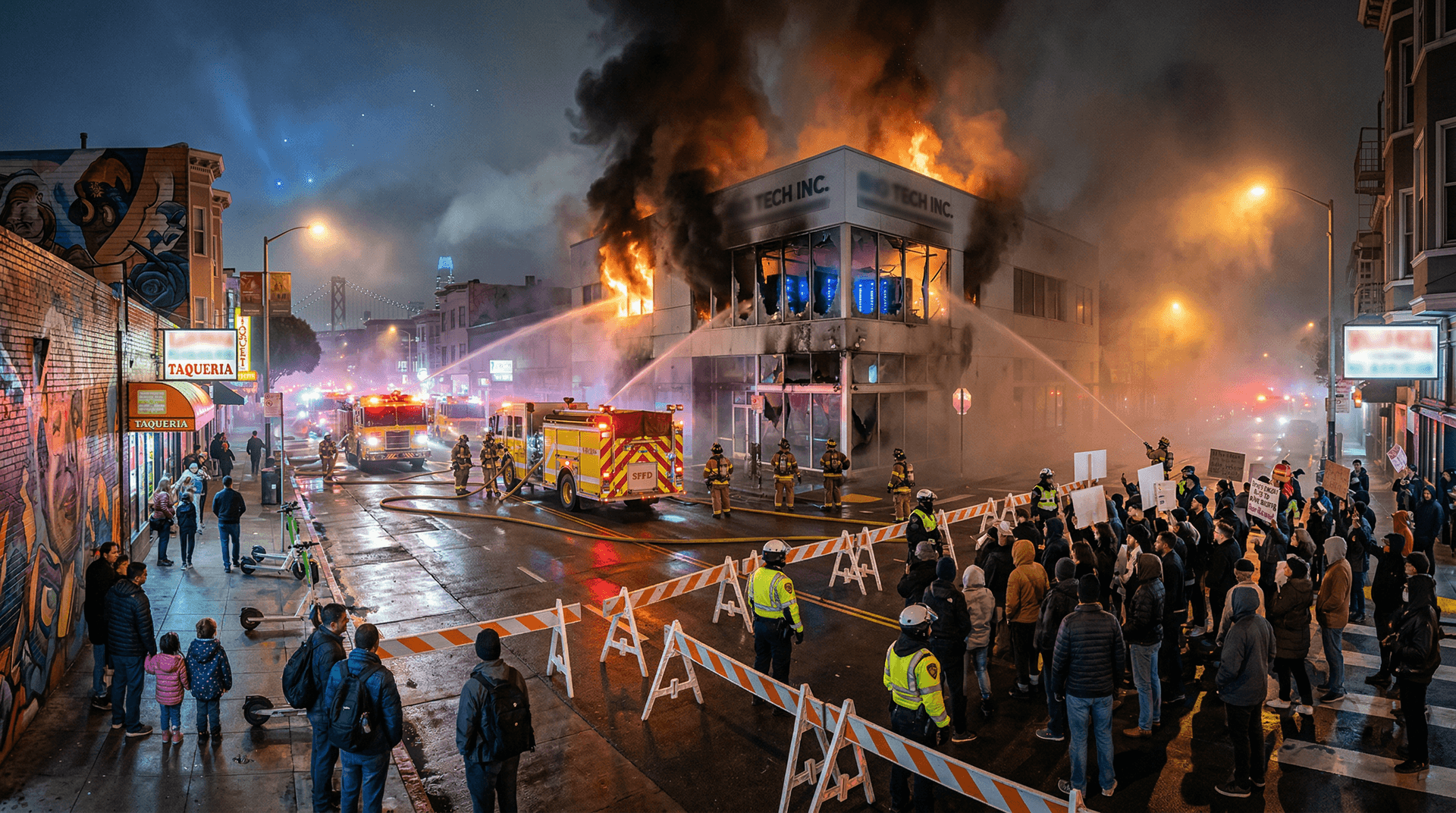
The San Francisco AI attack targeted OpenAI's Mission District lab with a Molotov cocktail on April 14, 2026. Attackers halted 24th Street transit for six hours. AI tensions deepen urban divides.
Firefighters contained the blaze in 45 minutes, per San Francisco Fire Department reports. No injuries reported. The incident disrupted 200 daily BART commuters at 24th Street station.
Mission District Foot Traffic Plummets 28% Post-Attack
Foot traffic on 24th Street dropped 28% by noon, according to StreetLight Data. Pre-attack hourly pedestrian counts hit 15,000. The decline echoes 2025 Seattle Capitol Hill protest effects.
Taqueria El Paisa owner Maria Gonzalez reports 35% fewer lunch patrons. Empty tables dot her neon-signed storefront amid vibrant murals. "AI labs create jobs but ignite tensions," Gonzalez states.
Valencia Street bike lanes saw 12% fewer cyclists. SFMTA data shows 450 fewer Route 49 bus riders. Merchants face revenue hits.
Stakeholder Views: Planners Versus Tech Advocates
SF Board of Supervisors President Aaron Peskin blames unchecked AI growth in residential zones. Peskin pushes zoning buffers for AI sites. His office logs 17 incidents since 2024.
OpenAI spokesperson highlights 150 jobs added last year. SF Chamber of Commerce data credits AI firms with $2.3 billion USD to local GDP in 2025.
MIT Senseable City Lab director Carlo Ratti compares San Francisco to Singapore. "Singapore zones AI data centers 5 km from residences, cutting protest risks 40%," Ratti tells Wired.
Crypto Markets Surge Amid Urban Fear
The San Francisco AI attack rattles finance. Alternative.me's Crypto Fear & Greed Index fell to 21 (Extreme Fear). Bitcoin climbed 4.8% to $74,421 USD.
Ethereum jumped 8.6% to $2,376.02 USD. XRP gained 3.4% to $1.37 USD. Traders eye crypto as a hedge against AI-hub volatility.
Glassnode reports $1.2 billion USD in Bitcoin exchange inflows post-attack. PitchBook data shows SF funds 62% of U.S. AI startups, now under valuation pressure.
Comparable Urban AI Tensions Elsewhere
Seattle's 2025 Capitol Hill protests against Anthropic cut rents temporarily. Foot traffic recovered after 18 months, per city records. New York shifted AI labs to Brooklyn Navy Yard, lifting property values 7%.
London's Camden AI clashes dropped Northern Line ridership 22%. UK planners require community input for AI projects. San Francisco relies on voluntary guidelines.
Distributed AI Research Institute founder Timnit Gebru warns: "AI displaces jobs, dividing cities like San Francisco where 40% of tech workers exceed $200,000 USD annually." Bloomberg backs her wage gap analysis.
Tech Security Upgrades Reshape Neighborhoods
OpenAI deploys $500,000 USD in perimeter drones. SFPD adds 24/7 surveillance at 20 AI sites. These changes alter Mission District's brick walls, graffiti, and privacy.
Zoning drafts cover 10-block radii around labs. Planners forecast 15% office-to-residential conversions. EPA predicts 8% air quality gains from lower server emissions.
Hybrid work dominates: CompTIA data indicates 62% of SF tech workers hybrid. Violence boosts remote work, cutting transit 11%.
Finance Angle: Investor Flight from AI Hubs
CBRE notes 9% drop in SF property investment for Q1 2026. AI violence scares off $450 million USD in venture capital. Crypto holds: BNB rises 3.1% to $616.46 USD.
Venture firms eye Austin's residential-free AI zones. Austin transit grew 22% post-relocations. San Francisco weighs tech density against livability.
Tonight's Mission Cultural Center meeting draws 300 residents. Input influences May 1 zoning vote.
Path Forward After San Francisco AI Attack
SFMTA forecasts 20% transit recovery with secure lanes. Tokyo's green buffers shrank AI protest zones 65%. May 1 council vote tests stability versus tech exodus in the San Francisco AI attack aftermath.